Promises Made, Promises Broken
The woman in Room 418 was ready to go home.
Lorraine had been ready since 9:45 in the morning, after she'd eaten the last of her breakfast, left the hospital gown in the bathroom bin, and got dressed in the pull-on pants and tunic her daughter had brought the day before. She wrapped wet paper towels and then a plastic baggie around the stems of the flowers her book club friends had sent. She placed them gently on the bed, everything in order. Relaxed and eager to go home, she settled into the chair by the window overlooking the parking lot, her purse perched on her lap.
Four days earlier, a pain in her side had been so severe that she went to the emergency room and was quickly admitted and prepped for surgery. Her appendix was inflamed and needed to be removed. Fortunately, it was caught quickly, and the surgery was completely successful. By the second day her fever had broken and early on the third she was walking the hallway. There was nothing left to do but go home.
Her daughter, Meg, arrived at 10:15 and greeted Lorraine with a long hug, a warm embrace filled with relief.
Mother and daughter sat together and waited, filling the time the way families do – wondering what was left in the refrigerator at home, what time the dog had been fed and how much he had missed her, and whether the afternoon traffic would make the drive home longer than usual. Small talk, really, but the comforting kind that reminds you that ordinary life is waiting just outside the door. And after these harrowing few days, nothing sounded sweeter than the return to that ordinary life.
They waited. And waited. They shared their Wordle results. They flipped through old magazines, not really reading them.
Every so often Meg would slip to the doorway and peek down the hall, hoping to catch sight of someone heading their way. Frustration was building in both, the kind that passes between two people with a look rather than words. And yet neither felt comfortable walking up to the nurses' station. After all, Meg thought, these were the people still responsible for her mother's care, and the last thing Meg wanted was to be seen as difficult. The staff moved through the hallway with the urgency of people with more pressing things to do. Meg and Lorraine could wait, they resolved, though not knowing how long was almost harder than the waiting itself.
By noon, the flowers began to look a little tired. At 12:30, the midday pangs of hunger set in. Since the hospital's stated commitment was to discharge patients before noon, Lorraine had not been included on the lunch schedule. So, at 12:40, Meg went down to the hospital gift shop and bought two small packs of cookies, one for each of them.
By 1:35, when the harried discharge coordinator finally appeared in the doorway with apologies and paperwork, Lorraine had been sitting with her purse on her lap for over three and a half hours.
It wasn’t until 2:25 that afternoon that Lorraine and Meg finally walked out the hospital doors and headed to their car.
Two days later, a patient satisfaction survey arrived in Lorraine’s email. As she began to complete the survey, whatever the exceptional nurses had done for her during those four days – the tireless patience, the careful explanations, the comforting hand during a difficult moment in the recovery room – almost none of it seemed to come to mind.
Instead, her thoughts kept returning to being marooned in the chair, the parking lot visible from her window that she had gazed at until every car was familiar, the once lovely flowers now wilted, the weight of her purse in her lap. The seemingly interminable wait.
I often refer to Lorraine when I explain the challenges hospitals face, wanting to be sensitive to patients but often lacking the operational capacity to do so. In the grand scheme of what could go wrong in a hospital, Lorraine’s experience was not serious, for sure. It could easily fly under the hospital’s radar, chalked up as an unavoidable inconvenience, a hiccup rather than a calamity.
Were it only that simple.
By and large, patients don't file their experiences in neat compartments, weighing each element of their stay on its own merits – the nurses were skilled and friendly, the food mediocre, the room too cold, the bathroom clean. They leave with an overall feeling, and that feeling is often shaped by the very last thing that happened to them.
I learned about Lorraine, and so many patients with a similar experience, while consulting with this hospital that had become baffled by its declining patient satisfaction scores. The ratings of the nursing staff had dipped from the year before. The food, the cleanliness, the friendliness of staff – all okay, but weaker. And yet nothing had really changed. Staffing was the same, outcome statistics were on par.
The downward trend was puzzling. But it was the scores on the critical final question that were most confusing, and ultimately the most telling. "Would you recommend this hospital to friends and family?" now averaged 3.2 on a 5-point scale, down from 4.5 a year earlier. In an era when many patients choose hospitals the way they choose restaurants – by reading reviews, comparing scores, and asking friends – that number is less a satisfaction metric than a referendum on survival.
About a year prior to my visit, the hospital had made what seemed like a generous, patient-friendly decision, that instead of their open-ended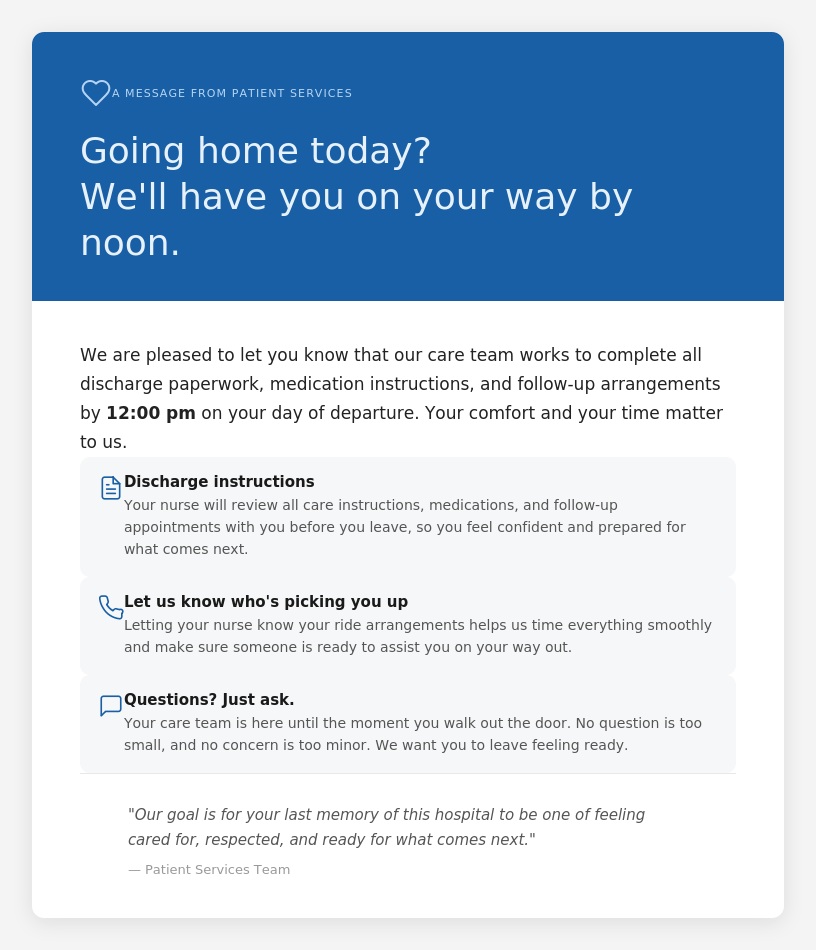 discharge time, patients would be discharged by noon. No more staying in a hospital bed all day twiddling their thumbs while paperwork cleared. No more uncertainty about when to arrange for the ride home.
Leadership proudly and publicly announced the policy, included it in brochures, and made it part of the admissions packet, something admissions staff reinforced in their conversations with every incoming patient. All were genuinely pleased to hear it.
But the promise was a bridge built from one shore without any certainty it could reach the other. The operational reality of a busy hospital – physicians completing rounds on their own schedules, pharmacy clearances, final assessments, homecare arrangements – meant that most patients had little chance of leaving until well after lunch. Often it was closer to 3 in the afternoon.
And so, with the very best of intentions, the hospital had constructed a factory for disappointment.
There is a certain cruel irony to unmet expectations that goes beyond the inconvenience itself. We don't experience time in absolute terms, but rather, we experience it relative to what we were told to expect. A 70-minute wait predicted to be 60 feels longer than the same wait predicted to be 90. The gap between promise and reality is where satisfaction lives or dies.
Most of us have felt this at a restaurant. The host says fifteen minutes, forty pass, and by the time you're seated, you carry a grievance even a sumptuous meal and gracious service can’t easily cure.
This hospital had fallen into that very trap. By promising noon and delivering 3 pm, patients were handed a cracked lens through which they evaluated everything – nursing care, food, cleanliness, the whole stay – refracted through that final broken promise.
The fix was straightforward. The hospital moved the announced discharge window to mid-afternoon, a realistic target the staff could hit. Patients who were advised to expect 3pm but were actually out by 1:45 felt genuinely respected and, not insignificantly, were back on the lunch schedule.
The discharge staff, no longer racing against an impossible clock, moved through their work more calmly and attentively. That is no small thing. Unhurried staff settle patients, and settled patients ask better questions, leave better informed, and take better care of themselves once they get home. The quality of a discharge conversation, it turns out, has greater influence than we typically realize.
The satisfaction scores from patients climbed, and not because the process had changed dramatically but because the promise and the reality were finally aligned, and the last memory of the visit was a positive one.
Lorraine had come to the hospital scared and in pain. She received great care, recovered well, and had every reason to leave grateful. She deserved to go home when she was told she would. She deserved to leave thinking about the nurse who held her hand, not about three and a half hours spent watching flowers wilt. And her nurses, who had given so much across four days, deserved to be remembered and acknowledged.
Somewhere in those three and a half hours, four days of excellent care unraveled in Lorraine’s mind. Not because the hospital failed her medically, but because it failed her at the one moment when she was simply counting on someone to deliver what they promised.
It is the nature of a memory to be cast in the shadow of a distinctive parting moment, the way a long and luminous day can be dimmed by the storm that closes it.